Pearson Edexcel · A-Level · Economics B
Course version: 9EB0 · Version from Sept 2015
B) Barriers to entry: o product differentiation o branding o start-up…
Full specification wording
Barriers to entry: b) Barriers to entry: o product differentiation o branding o start-up costs o intellectual property rights o R&D and technology change
Barriers to entry are obstacles that make it difficult for new firms to enter a market, protecting the monopoly power and supernormal profits of incumbent firms.
Checked against the Pearson Edexcel 9EB0 specification (opens in a new tab) on .
- Point 2 of 4
- 3 key terms
Study notes
From the checked teaching notes for this specification point.
The idea
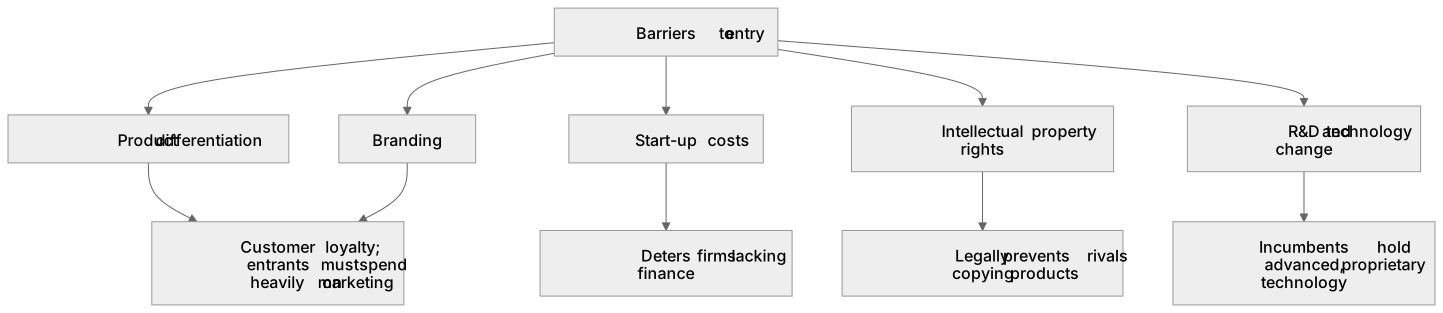
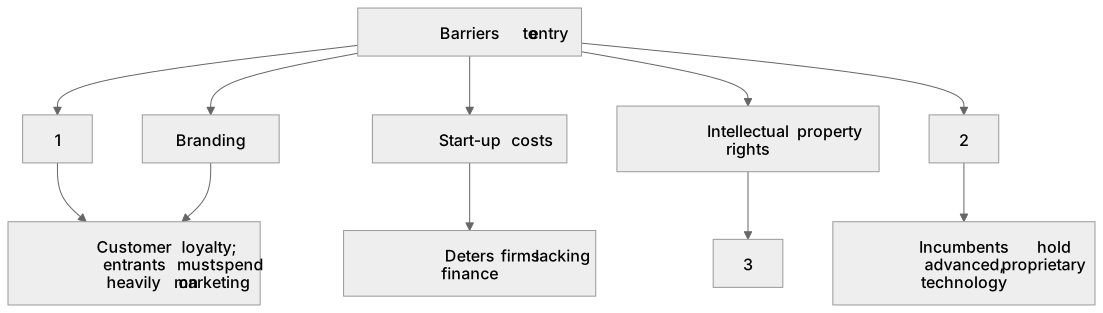
Barriers to entry are obstacles that make it difficult for new firms to enter a market, protecting the monopoly power and supernormal profits of incumbent firms. Product differentiation and strong branding create loyalty, forcing entrants to spend heavily on marketing. High start-up costs, such as purchasing expensive capital equipment, deter firms lacking finance. Intellectual property rights, like patents and copyrights, legally prevent rivals from copying products. Finally, extensive research and development (R&D) and rapid technology change can create barriers if incumbents hold advanced, proprietary technology. For instance, pharmaceutical companies use patents and massive R&D budgets to block new entrants.
What earns the marks
- Identify product differentiation and branding as methods to create customer loyalty and increase entry costs for rivals.
- Explain how high start-up costs act as a structural barrier to entry.
- Describe how intellectual property rights provide legal monopolies and prevent imitation.
- Analyse how continuous R&D and technological change give incumbent firms a competitive advantage that is hard for new entrants to match.
Common mistakes and how to put them right
Stating that all start-up costs are sunk costs.
Put it right: Start-up costs can include recoverable assets like vehicles; only unrecoverable costs (sunk costs) are absolute barriers to exit.
Confusing patents with copyrights.
Put it right: Patents protect inventions and processes, whereas copyrights protect original artistic or literary works.
Assuming barriers to entry are always illegal or anti-competitive.
Put it right: Many barriers, such as branding, R&D, and patents, are legal and can result from natural market dynamics or government policy.
Exam tips
- Use specific examples of intellectual property, such as pharmaceutical patents, to illustrate legal barriers to entry.
- Evaluate how the internet has lowered start-up costs for many retail businesses, reducing traditional barriers to entry.
- Discuss how strong branding acts as an artificial barrier by making demand for the incumbent's product highly price inelastic.
Try the lesson
The start of the Barriers to entry: b) Barriers to entry: o product differentiation o branding o start-up costs o intellectual property rights o R&D and technology change lesson, made from checked teaching notes for this specification point.
Have a go first
Which of the following best describes how intellectual property rights act as a barrier to entry in a market?
Listen
Barriers to entry are obstacles that make it difficult for new firms to enter a market, protecting the monopoly power and supernormal profits of incumbent firms. Product differentiation and strong branding create loyalty, forcing entrants to spend heavily on marketing. High start-up costs, such as purchasing expensive capital equipment, deter firms lacking finance. Intellectual property rights, like patents and copyrights, legally prevent rivals from copying products. Finally, extensive research and development (R&D) and rapid technology change can create barriers if incumbents hold advanced, proprietary technology. For instance, pharmaceutical companies use patents and massive R&D budgets to block new entrants. A strong answer earns marks for these points. Identify product differentiation and branding as methods to create customer loyalty and increase entry costs for rivals. Explain how high start-up costs act as a structural barrier to entry. Describe how intellectual property rights provide legal monopolies and prevent imitation. Analyse how continuous R&D and technological change give incumbent firms a competitive advantage that is hard for new entrants to match. A common slip: Stating that all start-up costs are sunk costs. Instead, Start-up costs can include recoverable assets like vehicles; only unrecoverable costs (sunk costs) are absolute barriers to exit. Exam tip: Use specific examples of intellectual property, such as pharmaceutical patents, to illustrate legal barriers to entry.
See it
Key words
Say what each word means before you turn the card.
Intellectual property rights
Try answering aloud or in your head before turning the card.
Start-up costs
Try answering aloud or in your head before turning the card.
Competitive advantage
Try answering aloud or in your head before turning the card.
See every definition
- Intellectual property rights
- Patents and copyrights that legally prevent rivals from copying products.
- Start-up costs
- Costs such as purchasing expensive capital equipment that deter firms lacking finance from entering a market.
- Competitive advantage
- An advantage held by incumbent firms through continuous R&D and technological change that is hard for new entrants to match.
Label the diagram
Some boxes have lost their names. Pick the right name for each number.
1Box 1
2Box 2
3Box 3
There is more to this lesson
The full lesson goes on to check your understanding and help you earn the marks. Create a free account to carry on, with your progress saved.
A week of Premium from your first lesson · Then the free plan continues · No card, no charge
Test your understanding of Barriers to entry: b) Barriers to entry: o product differentiation o branding o start-up costs o intellectual property rights o R&D and technology change
Active recall beats re-reading. Take an instant quiz now to test what you’ve learned and lock it into long-term memory.
A week of Premium from your first lesson · Then the free plan continues · No card, no charge